Here I really should add that my wonderful husband helped me talk through all of my varied reactions to this movie - we discussed it as a standalone adaptation, as compared to the other adaptations of "Emma," and as contrasted to the rest of Austen's work - because he's knowledgeable enough about this to be able to really dig into the weeds with me, and patient enough to actually do it!
My initial thoughts about this interpretation of Emma when the very first trailers started trickling out were as follows:
1) Emma's hair looks like ramen;
2) Bill Nighy is playing Mr. Woodhouse as energetic and pedantic, which is not at all how he's portrayed in the book;
3) Everyone and everything is moving as though they have all been very carefully and strictly choreographed;
4) The men's collars are absurdly high;
5) Miranda Hart is bang-on perfect for Miss Bates and she will probably make all of this not matter.
That's literally exactly the substance of my first impressions, and in that exact order!
Now that I've seen it, obviously, there's a lot more to talk about and unpack.
First of all, the costumes. I stand by my initial reaction to the men's collars. They were positively ridiculous. There's fashionable, and then there's literally impeding one's movement and vision. Collars like that would only have been worn by the dandiest dandy who ever dandied about London, not a country squire and a country vicar. If you can't turn your head to speak to the person next to you without your collar smushing into your face, YOUR👏COLLAR👏IS👏TOO👏DAMN👏HIGH.
As an example of how high collars actually should be, here's Colin Firth in the 1995 adaptation of "Pride and Prejudice." Mr. Darcy is much, much wealthier than Mr. Knightley and Mr. Elton combined, spends a lot of his time in London, and yet...

(The reason he's not looking at Lizzy is because he's arrogant, not because his collar is in the way!!!)
Then we have Mr. Elton:

And Mr. Knightley

Was this enough to ruin this adaptation for me? No. Was it distracting as hell? Yes!!!
Speaking of Johnny Flynn as Mr. Knightley, he's definitely not "my" Mr. Knightley (every Janeite has one). I didn't much care for the shouting matches between he and Emma. She might shout, yes, but Mr. Knightley should have command of his temper and not let himself get caught up in it with her. That's the contrast between them - she's impulsive, he's contemplative. Having them squabble like siblings doesn't make them seem more like equals, it makes him seem unsteady. And while yes, Mr. Knightley softens and loosens up a bit in the course of the story, it's not because Emma gets him so riled up as to ruin his composure, it's because he realizes that the reason he is so critical of her is that he loves her and wants her to live up to her full potential rather than squandering her notable talents. Furthermore, Johnny Flynn just seemed sort of hangdog and petulant a lot of the time, rather than quietly observant. I guess he's the right age for the part (~36) but for me, being the right age for the part doesn't necessarily mean that actors *look* the right age for the part (see: Johnny Lee Miller of the perpetual babyface).
Something else I didn't understand was how this adaptation characterized Donwell Abbey itself. What was with all of the furniture being covered with sheets?? The only explanation I can come up with is that he didn't need them for his bed, because he was literally never there, instead crashing on one of the many unused sofas at Hartfield. That also seems like a reasonable explanation for his appearance always being sort of rumpled and unkempt (despite having valets who are shown literally dressing him from the skin out). I mean, could his hair have been any more wrong for the Regency?? It was much too long and blowsy and almost rakish. Maybe it was to make him look careless, but again, Mr. Knightley in the book is the epitome of careful - literally, full of care for his estate, for Emma, and for Mr. Woodhouse.
The book explains that Emma's home, Hartfield was "...but a sort of notch in the Donwell Abbey estate, to which all the rest of Highbury belonged." The master of such a large manor has to be a responsible landlord and farmer, which means being PRESENT and AVAILABLE at one's home in case any of the tenants or landholders had business with him. And one of them does! Robert Martin doesn't have to consult Mr. Knightley about proposing to Harriet, but he does so out of respect for his landlord's opinion. In the movie, it seems like Knightley has just kind of shut down shop at Donwell and left a card saying, "I'll be at or near Hartfield if anyone needs me." What's Robert Martin supposed to do, wander up hill and down dale until he finds him??
Moving on...
Apart from those collars, the costumes were probably the best thing about the adaptation. They were clearly intended to be a major aspect of the storytelling, and I definitely appreciated that. I almost gasped out loud when I actually saw the back of Emma's yellow pelisse (the long, high-waisted coat she wears in the movie poster). The fan pleating was STUNNING and just so sharp and elegant. The costumer, Alexandra Byrne, created an explosion of color and texture and got so many of the minor details just right.
But as much as I love and have studied Regency fashions, I'm not the best person for this particular aspect of film critique. Alden Tullis O'Brien, a dear friend of mine and a costume and textile history expert, has done a full blog post just focusing on the costumes in this film, which I highly recommend reading. She goes into which costumes are reproductions of actual gowns from the period, and which ones are composites of fashion plates and extants, the whole nine yards (I promise that's not a fabric pun...)
Here's her post: https://curatorscurio.com/2020/01/14/movie-costumes-emma-2020/
Unfortunately, my initial reaction to Emma's hair proved accurate. It totally, 100% looks like ramen. I don't know why she had itty bitty tight little ringlets and everyone else got the larger, soft curls that were more prevalent in the period. Maybe it was to set her apart somehow. But mostly it just made me nostalgic for college.

A few of the characters (notably, Harriet Smith and Jane Fairfax) had finger waves, which was completely bizarre. Maybe it was to set them apart as "poor" or "dependent?" I'm honestly not sure.


1823-skidoo!!
Speaking of things that I can only guess were intended to set apart "genteel" from "poor," the music in the film was pretty awful. I would have to look at a soundtrack list to figure out what the hell was going on in the minds of the music team, but you know what I can say with certainty wasn't around in Regency England?
AMERICAN SHAPE-NOTE HYMNS.
OH. MY. GOD.
That's all I'm going to say about that because it just gets me too worked up.
As for the portrayals of the different characters:
Emma
Jane Austen herself said that Emma was a character "whom no one but myself will much like," and Anya Taylor-Joy's Emma was decidedly not someone the audience could really sympathize with or warm to. One thing I really appreciated about this film was that it emphasized Emma's isolation and the sameness and monotony of her everyday existence. In a miniseries, it's possible to cover the source material very comprehensively and really draw out the details, but that's not always the case with a film adaptation. With this film, however, Autumn de Wilde squeezed out every spare moment she could and really took those moments to focus on the characters in between the action - walking toward each other, sitting down together, looking in each other's direction, etc. It really helped to demonstrate just how much downtime there was to fill in the lives of the Regency gentry. No wonder Emma feels the need to make matches and arrange everyone's lives for them - there's nothing to do!
In talking with my husband about this adaptation (which he didn't see, by the way) we realized that Emma is the only Austen heroine who doesn't venture beyond the confines of her village at all, neither before nor during the action of the story. The only exception, as far as the reader knows, is the honeymoon she and Mr. Knightley take to the seaside. Before that, her life is completely wrapped up in managing the household, caring for her father, visiting and providing for the genteel poor and the destitute in town out of duty and...that's about it. Miss Taylor's marriage is the first thing in her life that really brings about significant change, because she can no longer count on her as a companion and source of conversation and employment (the Regency term for "having something to do"). Without Miss Taylor, Emma is pretty much stuck at home, pacing around like a caged lion. But because she is clever, she wants to be busy and useful, and so she lights upon Harriet Smith as a person with whom she can be busy, and to whom she can be useful. Anya Taylor-Joy certainly portrays Emma's elegance, sense of her own cleverness and superiority. and the belief that whatever she does is above reproof. It's an interesting casting choice because she's so pixie-ish and otherworldly, not at all what I would think of as a typical Regency beauty, but her big eyes and overall somewhat youthful appearance does help remind the audience that even at 20, Emma is still very sheltered and has a great deal to learn.
Harriet Smith
Mia Goth was sufficiently deferential and admiring of Emma, but my problem was that I just didn't see what Emma saw in her. Harriet is introduced to Emma's notice by the schoolmistress Mrs. Goddard, and it's explicitly stated in the book that Emma is interested in meeting Harriet on account of her beauty. Harriet is described as"a very pretty girl, and her beauty happened to be of a sort which Emma particularly admired. She was short, plump and fair, with a fine bloom, blue eyes, light hair, regular features, and a look of great sweetness." While one imagines that Emma wouldn't want to select as her protege someone whose beauty outshines her own, there has to be something that Emma latches on to, and I have to say, that didn't come across with this casting decision. Harriet was kind of whiny and put-upon, rather than naive and optimistic. And this is another directing issue, but I didn't understand why, at the end, she accused Emma of wanting Knightley for herself (Harriet doesn't possess that kind of "penetration," as Austen would say) and also threw in Emma's face the fact that she had ruined her chances with Robert Martin. It was jarring for Harriet to suddenly have such insight into what had really happened and what Emma's true motivations were.
Mr. Woodhouse
"Sprightly" is not a word one should associate with Mr. Woodhouse, but here we are.
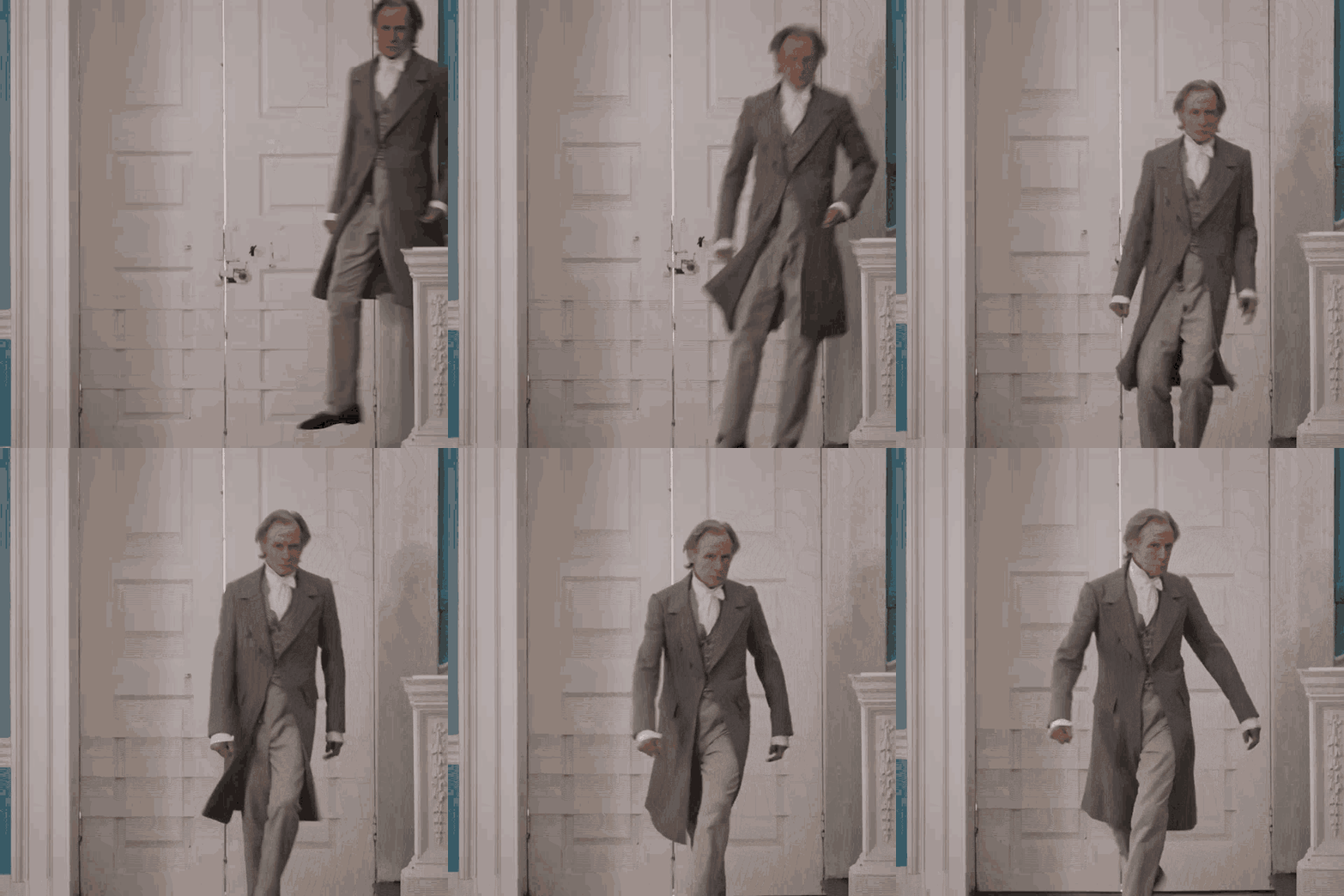
I'm sorry, but yes, it did still bother me that Bill Nighy came rushing down the stairs and landed with a flourish at the bottom on the morning of Miss Taylor's wedding and resolutely gathering everyone to leave. That's an event he would have to be dragged to kicking and screaming! Complaining about Mr. Elton's pronunciation of "innocence" does not a valetudinarian make. I mean, yes, he did fret about "the draughts" once or twice, and fuss about what other people were eating occasionally, and he's shown with a veritable citadel of folding screens placed around him at the end (with Emma and Knightley seizing the opportunity by snogging in the same room?? YUCK!). I thought I would like Bill Nighy more as I got to see more of him than just what was shown in the trailer, but he was just not the Mr. Woodhouse from the book. And the relationship between him and Emma has to be really loving and solicitous, from both of them. He kind of seemed indifferent to her, and she to him. I was extremely surprised that I started welling up as he walked her down the aisle for her wedding, because Bill Nighy did a wonderful job of showing Mr. Woodhouse's sadness at yet another change to his settled way of life - but where was that affection and concern for her during the whole two hours of the movie??
Mr. Elton
I think Autumn de Wilde conflated Mr. Elton and Mr. Collins. That's the only explanation I can think of for how *smarmy* Josh O'Connor made him. Mr. Elton is supposed to be overly gallant, always dropping compliments to the ladies, but he's not supposed to be creepy. Self-important, yes - he believes Emma to be encouraging his suit and believes that he is worthy of her wealth - but the suggestive eyebrow-waggling was a bit much. I did like the showiness of the music box frame he got for Harriet's portrait. That was pretty silly. And the fact that it wasn't actually mechanized to open when he clapped, but the servants having to do the actual reveal? Pretty clever. Which brings me to...
The Servants
This is one of the adaptations that really hits home just how much drudgery it took to uphold the lifestyle of the gentry. The ever-present servants in this adaptation were a very nice touch, right there when something needed to be brought in or taken away, appearing as if by magic and then disappearing when no longer necessary (part of that highly stylized and precise choreography I mentioned up above). And as this adaptation makes extremely clear, the servants are there to do their work, not to provide companionship. Emma and her father are surrounded by a veritable army of valets and grooms and maids, but they are still isolated and lonely. I particularly want to highlight the death glare that one of the maids gave to Mr. Elton when he unceremoniously threw off his scarf and it hit her square in the face. That was pure gold.
Mrs. Elton
I think my biggest issue with Mrs. Elton is that the inhabitants of Highbury only learn that Mr. Elton is married because Mrs. Elton shows up in church one day. What???? There were letters! Everyone knew about it well before he brought her home! Grrr...
Anyway, this was one of the characters who unfortunately got short shrift, in more ways than one. I loved her over-the-top and early-adopter whackadoodle 1830s hairstyles, but she's the interloper everyone is supposed to be put off by, and she almost wasn't...insufferable enough?? All we got from her was that she called Mr. Knightley "Knightley" and talked about Maple Grove once or twice. Oh, and she offered to have one of her servants collect Jane Fairfax's letters, and that was it. No taking Jane under her wing, no insisting on helping her apply for governess positions, nothing! Jane had no real reason to leave the Donwell party early. This adaptation really took the bite out of Mrs. Elton, and that was a loss.
Speaking of which...
Jane Fairfax and Frank Churchill
Where was the mystery? Where was the intrigue?? No alphabet game, no Perry's carriage, just the pianoforte and a few references to Weymouth. There was nothing to raise Mr. Knightley's suspicions about Frank and Jane that he could warn Emma about!
Side note - my daughter (who's 6, and came to see the movie with me and knows the main story of all of Jane Austen's novels) noticed that the actors playing Frank Churchill and Mr. Elton look like they could be brothers. And she's right!
Mr. and Mrs. John Knightley
Yes, Isabella is supposed to be the daughter who is most like her father - fancying herself and everyone else ill all the time - and yes, John Knightley is supposed to be rather brusque and standoffish. But my goodness, this adaptation made them SO unpleasant and snipish to each other and the rest of the family. It really makes their marriage appear to be an absolute misery for both of them. Which it's not supposed to be!! The whole point is that they are a couple who are not only well-suited by being neighbors and friends, but they have found happiness together (they have a veritable gaggle of children, you wouldn't expect people who hate each other's company to keep on procreating). Moreover, the whole point of George Knightley going away to London is that he is trying to remove himself from Emma's company because although he is extremely jealous of Frank Churchill, he is trying to do the right thing by giving way, and hoping that he will grow indifferent to her. But he stays with John and Isabella, and her resemblance to Emma and THEIR HAPPY MARRIAGE drive him home again to throw himself into her arms!! The way they're played in this version, it's a wonder Mr. Knightley doesn't write marriage off completely.
Miss Bates
Oh, Miranda Hart, you are always perfect. And yet so underused!! Autumn de Wilde had a gem in her hands and placed it in such a paltry setting as to dim its shine. Miranda Hart could have run circles around everyone else with this role if she'd just been given free rein! Oh, and if you have any doubts about Miranda Hart's acting abilities, since she's so well known for comedy, you can rest assured that she was positively devastating in the Box Hill scene. She just shrank and was so visibly wounded by Emma's words. Although I gotta say, I took some issue with the line given to Emma.
Here's how it goes in the book, after Mr. Churchill tells everyone they must share "either one thing very clever, be it prose or verse, original or repeated, two things moderately clever, or three things very dull indeed."
Miss Bates replies with, "Oh! very well...then I need not be uneasy. 'Three things very dull indeed.' That will just do for me, you know. I shall be sure to say three dull things as soon as ever I open my mouth, shan't I? (looking round with the most good-humoured dependence on every body's assent) Do not you all think I shall?" Emma responds, "Ah! ma'am, but there may be a difficulty. Pardon me, but you will be limited as to number -- only three at once." In this adaptation, Emma said something "But Miss Bates, when have you ever stopped at three?" Which is a much snippier and biting reply, I guess, but it seems to me like the comment Emma makes in the book is plenty bitchy. Autumn de Wilde really did try to lean into the "Mean Girl" aspects of Emma's character.
I liked how Johnny Flynn did the "Badly done!" speech, but even though he did it well, he's still not the right guy for the job, in my opinion. He's just too...scruffy. I don't see how Emma, the picture of wealth and elegance and health, could fall in love with a guy who doesn't appear to own a hairbrush.
And then we have...
The nosebleed
Probably the worst WTF moment in the whole adaptation. Apparently Autumn de Wilde herself gets nosebleeds when she's stressed or feels like things are out of control, but for goodness' sake, couldn't we have had some context?? If Emma had gotten a nosebleed on the morning of Miss Taylor's wedding, for example, we would know that this is A THING that happens to her when she experiences some kind of upheaval. And then when Mr. Knightley is professing his love, it would kind of come full circle if she got a nosebleed again. But me being a costumer, all I could think of was the potential of staining the lovely gown she was wearing in that scene. Yikes!
I will probably think of several other things I want to mention about this adaptation, but that seems like plenty for now, wouldn't you agree??

I can't argue with any of your observations; however, I must add that I very much enjoyed the film as a comedy of errors and a drama of miscommunication. I was positively drooling over several of Emma's costumes. I'm almost inspired to get out the embroidery! Almost.
ReplyDeleteI see what you mean. Though Jane Austen so deftly wrote comedy and drama in her own brilliant way, that whenever it's exaggerated or magnified, it just feels like gilding the lily. I just think the comedy and drama speak for themselves and some directors just need to be willing to get out of the way and let the work shine.
Delete